

Digital technologies, including AI, represent a significant opportunity
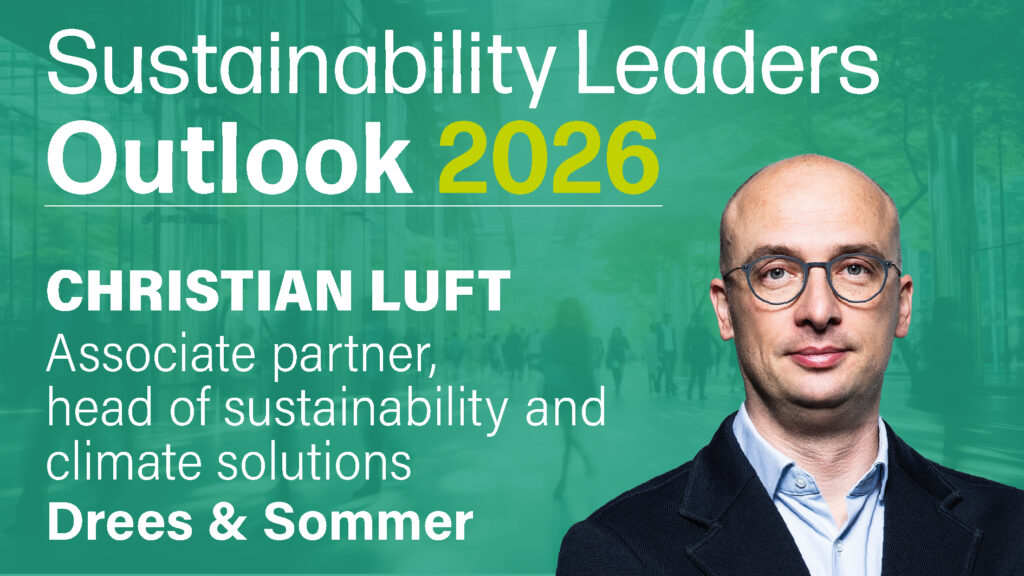
How do you assess the real estate sector’s progress on sustainability in 2026?
Sustainability has moved decisively from being a trend to becoming an economic necessity. In 2025, geopolitical uncertainty further complicated an already challenging real estate market, while sustainability requirements added additional pressure. At the end of 2025 and into early 2026, however, there are increasing signs that the sector has passed the lowest point. Market uncertainty has eased, and there is renewed momentum to pursue viable, long-term solutions.
From my perspective, this is absolutely essential. The challenges are particularly significant with existing building stock. Without ambitious targets, consistent transformation strategies, and a clear prioritisation of energy-efficient retrofits, it will be difficult to meet the required political and environmental transition pathways. The coming years will therefore be critical in closing the gap between stated ambitions and actual implementation, and in ensuring the long-term resilience of the real estate sector across Europe.
What would you say is the biggest issue facing the sector when it comes to sustainability – is it decarbonisation, regulation, certifications, technological innovation, including AI, or something else?
The greatest challenge remains the already tense economic situation. Persistently low returns across large parts of the real estate sector leave very limited scope for additional investment, including in sustainability-driven innovation or enhanced technical specifications. Yet this flexibility is precisely what is needed during a period of fundamental transformation, when established approaches must be rethought and new, future-proof solutions developed.
In this context, digital technologies, and AI in particular, represent a significant opportunity. They enable new approaches to be implemented more quickly, efficiently, and at scale. Through automation, data-driven decision-making, and intelligent planning tools, transformation processes can be delivered in a more economically viable way, especially where scarce resources would otherwise become a limiting factor.
What are your specific plans and key priorities for 2026 and what are the main obstacles you see on that path?
For us, sustainability is not an add-on but a core lens through which we assess both current projects and future opportunities. A key example of this commitment is our new headquarters development in Stuttgart, where we are implementing an innovative, simplified construction approach that supports circular-economy principles and improves material efficiency across the lifecycle of the building.
Beyond new developments, and as already highlighted earlier, existing building stock represents one of the greatest levers for achieving climate and sustainability objectives.
In 2026, this will be a clear focus of our work. We are supporting clients in deploying often very limited capital in a way that delivers the greatest real estate value, while measurably improving sustainable quality and enabling ESG requirements to be met in a highly economic manner.
In parallel, we are expanding our focus to emerging sustainability dynamics, particularly the role of water as a critical urban resource. This includes developing holistic concepts that integrate sustainable water access, climate-resilient urban water solutions, and future-ready infrastructure into the built environment.
Delivering solutions of this kind requires political and regulatory stability. Construction and infrastructure projects typically span many years, and frequent, short-notice changes to regulation or funding frameworks create uncertainty that undermines long-term, sustainable planning.
Our approach is to focus first on what is genuinely required and to define clear, project-specific standards on that basis. By doing so, we can develop economically robust concepts that align sustainability with future requirements and help bridge the gap between ambition and implementation across the real estate sector.
Related articles
- BREEAM New Construction Version 7 marks shift to Whole Life Carbon assessments
- Sidelining sustainability in projects is a mistake
Christian Luft, Drees & Sommer
