

Briefing: strong sustainability credentials unlock financing
Strong sustainability credentials and a good location are the key to unlocking financing, experts on the Debt Finance Outlook panel agreed at the European Investment Outlook briefing, organised by Real Asset Media and Sociëteit Vastgoed and hosted by CMS at their offices in Amsterdam.
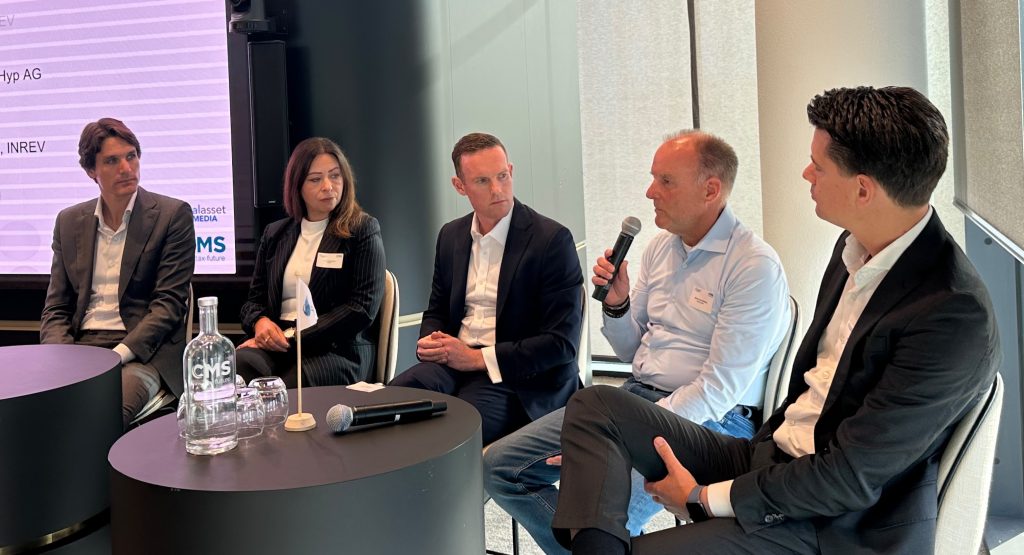
“Loans are linked to the ESG status of the building and the capex needed to upgrade it during the term of the loan”, said Dennis de Laat, Head of Real Estate Finance Benelux, Berlin Hyp. “It is a crucial part of the risk assessment.”
Even in the current difficult and volatile market, if the asset can be improved and upgraded then the chances of finding finance are much higher.
“Location and sustainability are key issues, but even in the best-connected locations it is sustainability that makes the difference and creates the appetite”, said Enrico van Erkelens, CEO and Founder, Equity Estate. The investments done always make sense, he added, because they lead to green leases with tenants who are prepared to pay higher rents.
“There has been a big shift: if sustainability requirements are not met then it is a struggle to find financing”, said Etiënne Courbois, Advocaat / Partner, CMS. “It is something that has really impacted the availability of credit. In other parts of the world it is less of a concern, but in Europe buildings have to be Paris-proof.”
There is definitely a contrast between expectations in Europe and elsewhere when it comes to sustainability. “If you raise capital from the US it is probably best not to mention it at all, while European and Canadian capital is still very much focused on sustainability”, said Richard Craddock, Head of Real Estate Debt, Redevco. “In Asia it is seen in terms of value creation.”
Redevco’s strategy focuses on retrofitting existing buildings. “It is the most undersupplied segment of the lending market”, said Craddock. “There is a massive demand for capital. Banks are being constrained by Basel 4 and capital is more expensive for extensive refurbishments, but the market is increasingly brokered, meaning we are seeing better pricing structures and better visibility.”
The majority of assets in Europe need some kind of retrofitting or upgrade, so the demand for capital will continue to intensify. From a market perspective it makes sense to do it because it creates a liquid asset.
Liquidity in the market is an issue, said van Erkelens: “There is almost no equity available to invest in real estate, because the strategy has changed and people raise debt instead of equity”.
The market is also dealing with rising interest rates and unprecedented volatility, which is impacting transaction volumes.
“The market is dominated by refinancing activity and we do not see many new transactions”, said de Laat. “Senior loans are available, and we hope that foreign investors will start pouring in equity again. In the meantime, we work on refinancing.”


