

EXPO Real 2026: AI fuels German data centre demand as expansion faces barriers
Data centres emerged as one of the main themes at EXPO Real on Monday, with AI driving demand for facilities in Germany. High energy costs and local opposition could constrain expansion, however, as developers prepare for more intensive computing requirements.
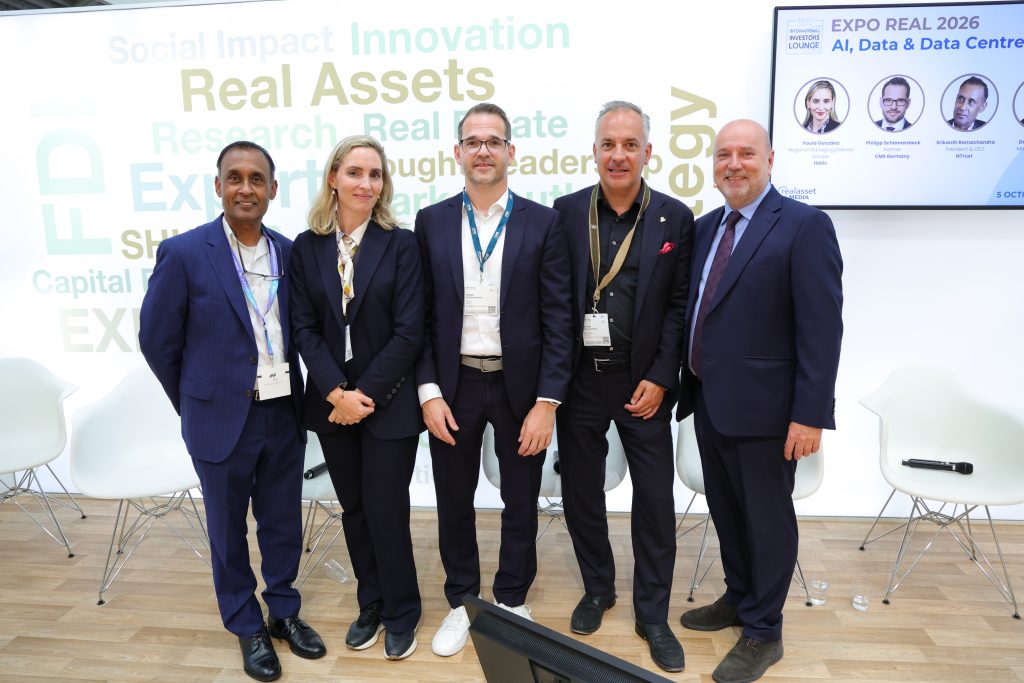
The opportunities and obstacles were discussed at the “AI, Data & Data Centres” session, moderated by Richard Betts. Philipp Schönnenbeck, partner at CMS Hasche Sigle, the law firm, said Germany’s data centre growth had largely been driven by cloud migration, digitalisation and requirements for data sovereignty. The full wave of AI demand had yet to reach the country.
“The design is more targeted to be AI ready,” he said.
Larger campuses were being designed to accommodate AI or cloud services at higher densities, although their eventual use was not always clear. Schönnenbeck said some larger projects had been abandoned because of insufficient public support, while Germany’s high energy prices made it a challenging location for large AI facilities.
He said the German government’s ambition was to double data centre capacity and achieve fourfold growth in AI data centres by 2030. Delivering that strategy would depend on implementation at municipal level.
Schönnenbeck called for greater public acceptance of the infrastructure underpinning everyday technology.
“We will have more data centres and maybe what we still need is a bit of a mind change in the sense of that people become aware that they are using AI every day,” he said.
Srikanth Ramachandran, president and chief executive officer of NTrust Infotech, the technology-enabled services company for commercial real estate, argued that Europe had an opportunity to distinguish itself through environmental standards.
“I think Europe can take a lead to see how the data centres are to be done in a more environmentally favourable fashion,” he said.
Environmental concerns were becoming more prominent in the US, where some states were imposing constraints on data centre expansion, he said. The debate there was focused more on environmental impacts than on the ethical questions surrounding AI.
Paula González, regional managing director, Europe, at Hollis, the independent technical services consultancy, said investors needed to understand the asset class’s technical complexity.
“Data centres are a very unique asset class, because it sits at the intersection of infrastructure and power capacity and cooling,” she said.
Due diligence required scrutiny of technical performance, environmental considerations and fire safety. Data centres also needed appropriate cooling, backup systems and advice reflecting the requirements of both asset managers and occupiers.
González said AI could also help optimise the operation of buildings, including data centres. She expected continued AI adoption and the emergence of new businesses to support further demand for the facilities.
The discussion highlighted the controls needed as real estate companies expanded their use of AI. Ramachandran said experimentation was giving way to closer scrutiny of costs, security and data quality.
“The questions now at the industry is not about, should I use AI? It is about, how do I control it? How do I manage the cost? And how do I scale it without blowing my budget?”
He said AI was accelerating processes including data aggregation, acquisition analysis and underwriting, although human review remained necessary when extracting information from documents. Fragmented data and documents remained a fundamental challenge for the industry.
Dominik Brunner, managing director of ARELIO, the real estate IT consultancy, identified three risks: “data leakage, over-reliance and bias building”.
“You have the risk that people rely too much on the output,” he said.
Uncontrolled technology use within organisations could compound those risks, Brunner warned.
Looking ahead, Ramachandran expected security and governance to shape adoption over the next year, with AI agents increasingly supporting activities from acquisitions to financial reporting over five years.
Schönnenbeck expected AI to drive further data centre growth over the next 12 months, reinforcing the need for communities to accept development.
Brunner identified cyber security as another growing priority as AI created more opportunities both for intrusions and for defending against them.
“Cyber security is going to be one of the big topics in the next 12 months,” he said.


