

Exclusive: Chinese logistics demand in Europe is structural and set to grow, GARBE says
Chinese and other Asian companies are becoming an increasingly important source of demand for European logistics space as they build distribution networks, localise inventories and take greater control of their supply chains, according to GARBE Industrial.
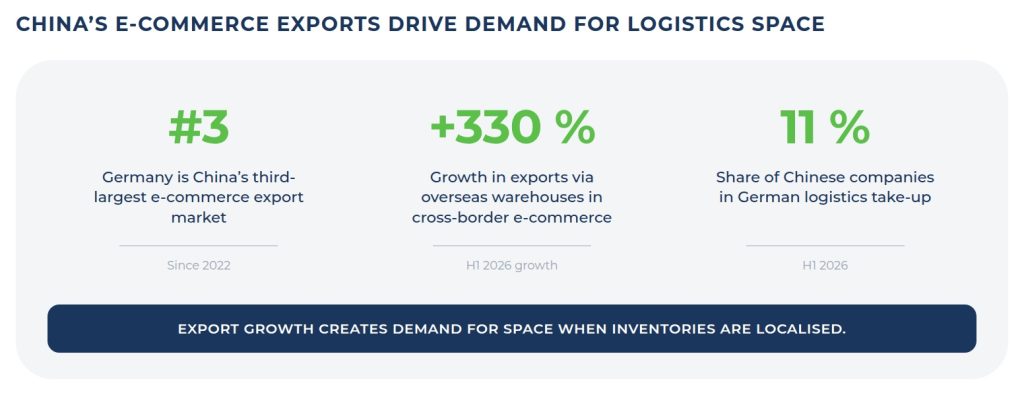
Asian occupiers accounted for 11% of logistics take-up in Germany in the first half of 2026, compared with a five-year average of 5%, Yingnan Yao, head of business development, Asia Desk, at GARBE Industrial, told a GARBE PYRAMID 2026 webinar on 3 September organised in association with Real Asset Media.
Yao said the increase was more than a short-term response to changes in trade policy.
“I think this shift, this growth is structural,” she said. “Of course, it was stimulated by some external factors, but as long as China still holds this world beating supply chain, and as long as Europe is still one of the most lucrative single markets in the world, Europe will remain one of the most important overseas markets for Chinese and Asian companies.”
She said Chinese logistics companies were increasingly establishing their own infrastructure overseas, citing JD Logistics, GoodCang and Cainiao as companies building warehouse networks and local logistics capabilities in Europe and elsewhere.
Yao contrasted China’s emerging logistics groups with established logistics companies from other major exporting economies, pointing to DHL, Kühne+Nagel and DB Schenker in Germany and Nippon Express in Japan. China has historically had fewer comparable international logistics groups, but she said companies such as JD Logistics, GoodCang and Cainiao were now developing their overseas networks.
“I think that suggests a move from short-term market entry and just exporting to a more permanent infrastructure footprint,” Yao said.

Yao did not predict how far the 11% share of German take-up could ultimately rise, but said Chinese companies were increasingly controlling more of their value and supply chains.
“That means there will be, for me, a continued growth of take-up in the next couple of years at least,” she said.
Germany has been China’s third-largest cross-border e-commerce export market since 2022, behind only the US and UK. Yao said the distribution model was changing, with goods increasingly arriving at local warehouses before being distributed to European consumers rather than being shipped directly from China to individual households.
Chinese e-commerce platforms including Shein, Temu, JD.com and AliExpress are expanding their European presence, while manufacturers in sectors such as e-mobility, green technology and batteries are creating requirements for logistics space for components, spare parts and finished products.
Companies are also adding local inventory buffers and moving from a just-in-time towards a “just-in-case” approach, creating additional demand for logistics space.
Yao said Asian occupiers typically prioritise immediate availability, logistics connectivity, access to Chinese-speaking employees and, increasingly, the ability to store batteries. For 3PL and contract logistics providers, the requirement can be particularly urgent, with some having only four to eight weeks before they need to move.
Major gateways including Rotterdam, Antwerp, Hamburg, Valencia and Barcelona remain important, while rail and air connectivity make Liège, Frankfurt, Duisburg, Warsaw and Budapest attractive locations.

Battery logistics is also becoming increasingly important. Yao said China supplied around 90% of EU lithium battery imports last year, while Germany was the largest buyer of Chinese lithium batteries worldwide.
She highlighted the Ruhr region in North Rhine-Westphalia as particularly well placed to capture this demand.
“If there is a vacant warehouse in the Ruhr region of West Germany, in North Rhine-Westphalia, it would tick all the first three boxes,” she said. “And if this warehouse can store batteries, it would have been rented yesterday.”
Speed can be critical when dealing with Asian occupiers. Yao said GARBE had completed one transaction from first viewing to signature within ten working days.
“This does not mean compromising diligence, but running the commercial, technical, and legal work streams in parallel,” she said. “Keeping up with the occupier’s speed is a signal of priority and efficiency.”
Chenhui Xia, managing director of GARBE Capital & Strategy Asia, said the impact extends beyond Asian occupiers because European logistics companies also service Chinese customers.

“It does create a demand momentum driven by Chinese companies going overseas,” Xia said. “It has not necessarily just turned into a Chinese tenant. It can also drive the demand of German, UK, Danish, French 3PLs.”
Tobias Kassner, head of research and member of the executive board at GARBE Industrial, said Asian occupiers were among the sources supporting European logistics take-up at a time when the development pipeline was declining.
“Looking at the market fundamentals, it’s important to note that the take-up is again quite stable, even increasing,” Kassner said. “The end of 2025 was quite good and this was not only, for example, like the tenants from the defence sector who are entering now the markets and will play a bigger role in the next years, but also Asian tenants.”


