

CEE Summit: repurposing assets a key decarbonising tool
Repurposing buildings is one of the key tools to decarbonise real estate, delegates heard at the ´Transforming Real Estate Assets: When, Why & How?´ panel at the recent CEE Summit, organised by Real Asset Media and The Poland Observer which took place in Warsaw.
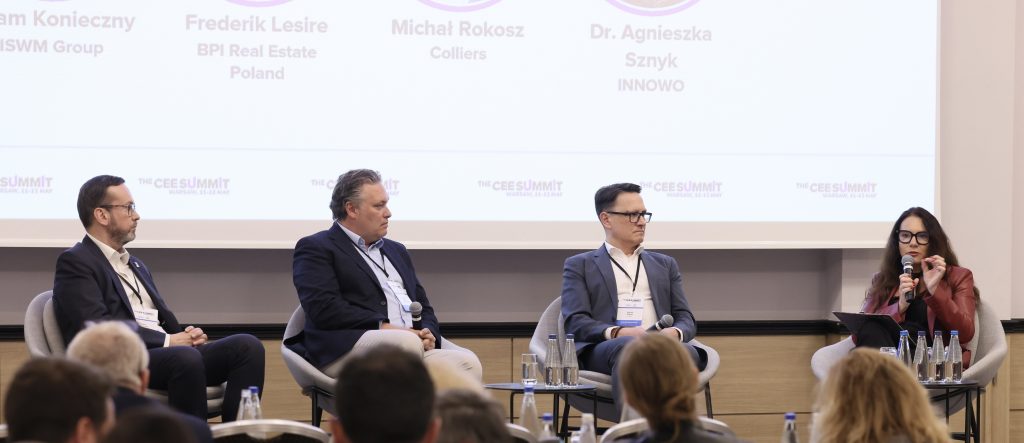
¨Repurposing is better than building from scratch because as the building is already standing you do not have permit issues, and also because as real estate developers we have a huge responsibility to try to lower CO2 emissions¨, said Michał Rokosz, Director, Real Estate Repositioning Advisory, Colliers. ¨We know the most sustainable building is, of course, the one that is already built.¨
The best opportunities are repurposing office buildings which are obsolete or no longer needed into some form of residential, which is in great demand across Europe.
¨We recently converted an office building into student accommodation in Lipowe, Poland, on behalf of a client¨ said Rokosz. ¨I would say that for a building to be successful the location is important. I personally deal mostly with conversion of office buildings into residential. It could be student accommodation, it could be PRS, it could be a hotel. I think this is the best way to work with buildings which are not functioning properly as office buildings, whether because they are vacant or not performing.¨
Belgium is a good test case for this type of conversion because, thanks to the presence of European Union institutions, it has a huge office market of some 12 million square metres.
¨As new supply comes, older buildings become redundant and there is oversupply¨, said Frederik Lesire, Country Director, BPI Real Estate Poland. ¨That´s when developers make their calculations to check if this building can be converted into residential, and if it is affordable. You need to check the free height and the quality of the concrete, especially underground. Also there is a lot of asbestos in Belgium. There are many questions to take into consideration, like do you have to reinforce the slabs or the columns, or do you have to replace them? Often the layout of an office building is not suitable for residential. Converting offices to residential is a very interesting process.¨
Agnieszka Sznyk, President of the Board, INNOWO, who moderated the panel, pointed out that buildings are no longer static assets, but they are becoming material banks, energy systems, and also strategic elements for the circular economy. ¨There is still a lot to do¨, she said.
Office buildings can also be turned into hospitality assets, which involves some risk and requires some imagination but can pay off, as one panelist´s experience shows.
¨We were working on an office building in Lviv, in Western Ukraine, which was due to be a bank, but then the bank decided to leave Ukraine and we were left with an empty building¨, said Adam Konieczny, Director of Hospitality Asset Management & Investment, ISWM Group.¨We were looking for a solution for this building, and we thought let´s try with a hotel, even if we didn´t have any experience with hospitality.¨
The search started for an international brand and for a management contract. Most big hotel groups said no because the project was too small for management, Konieczny explained, but ¨we persisted and finally reached a deal with Accor. And this hotel became Ibis Styles in Lviv, which is still operational. The project has been a success, even though it was challenging to adjust the building to hotel needs. But from the business point of view, it was a very good investment. And later on, we
decided to build another building on the same street, which is now Ibis Red in Lviv.
This is our story with hotels started.¨
What started almost by chance has continued: last year ISWM Group bought a famous office building in Warsaw, Nautilus, designed in the late 90s by Stefan Kuryłowicz, a famous Polish architect, and they are now in the process of converting it into a hotel.
¨We would like to do a lifestyle product with a rooftop bar, a difficult project, because this building is 27 years old, and there are a lot of challenges¨, said Konieczny. ¨But because of the location we believe it will be a successful project, because we will be able to achieve a quite good ADR and occupancy. So, despite the
difficulties, we believe it is the best use for this building.¨
Repurposing an asset is not necessarily cheaper than building from scratch, the experts agreed: it depend on the state of the asset and the level of ambition of the project.
¨In the past year we signed a contract with the European Commission for an old building from the 70s and to make it future proof for the coming 50 years, and we really had to change the structure of the building to get it ready as a modern office building, so it was challenging¨, said Lesire. ¨IThere were five floors underground, but we were only allowed to use three for parking, so in order not to lose the other two floors we created a 600 sq.m conference centre with just four columns. And this was actually what convinced the European Commission to rent our building because they needed the
conference centre. So we were ambitious, the cost was the same as building a new asset because of the detailed structural work, but in the end we are very happy that we took the risk in the beginning and did not just opt for a normal renovation because then I think we would not have had such a tenant.¨
In this era of scarcity of resources the European Commission is determined to make our economy more circular and there will be some fiscal changes that hopefully will make repurposing an old building cheaper than building a new one, said Sznyk: ¨It has to become one of the key tools of decarbonisation of the real estate sector.¨


