

Why don’t all warehouse roofs already have solar panels?
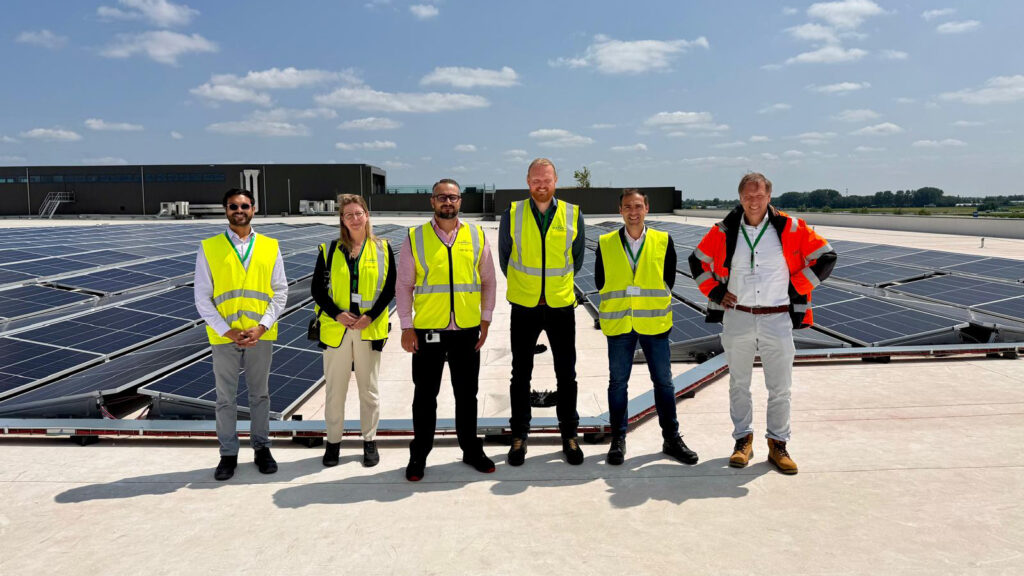
VerusSol believes the barriers to logistics rooftop PV are structural, not technical, and treating it as building improvement delivers benefits from day one.
With solar costs continuing to fall, grid capacity increasingly constrained, and energy price volatility showing no sign of abating, rooftop solar on logistics assets should be ubiquitous across Europe’s warehouse stock. Yet the vast majority of rooftops remain bare.
VerusSol has built a structured pathway, supported by an advisory team and a growing network of vetted photovoltaic (PV) and battery installation partners, that removes the barriers to deliver it at scale across European markets.
The paradox on Europe’s rooftops
Logistics real estate is one of the most sought-after asset classes in European investment — and with the sector’s fundamentals increasingly well-optimised, many of the remaining marginal gains in asset performance lie in effective and intelligent on-site energy generation.
Yet there is a paradox in plain sight: the vast majority of Europe’s logistics rooftops remain bare. The UK Warehousing Association estimates that installing solar across the country’s warehouse stock could double national solar PV capacity. In Germany, the continent’s solar leader, most warehouse rooftops are still underutilised. Across Europe, fewer than one in 10 logistics buildings generates its own renewable electricity.
The question is not whether logistics landlords should be deploying rooftop solar – the economic fundamentals alone make the case. Structurally, fossil fuels tend towards higher prices, supply volatility and geopolitical risk. Electrification powered by renewables moves in the opposite direction.
For logistics assets – energy-intensive, grid-dependent and increasingly operating in power-constrained urban locations – on-site generation is not a sustainability initiative. It is risk management, cost optimisation, and — when structured correctly — a direct driver of value creation through enhanced rental income, asset revaluation and improved fund-level returns.
The question is: why are more landlords not doing it?
The barrier Is not technology, it’s structure
The obstacles are well documented but persistently misunderstood. They are not primarily technical. PV technology is mature, cost-effective and proven at scale.
The barriers are structural: split incentives between landlords and tenants, regulatory complexity across jurisdictions, concerns about roof loading and building insurance, and the administrative burden of designing a model that works for every stakeholder in the value chain.
The split-incentive problem is particularly acute in logistics. The landlord owns the roof, but the tenant pays the energy bill. Third-party power-purchase agreements (PPAs) can address this, but they introduce external parties, dilute landlord control and create complexity around lease events, refinancing and exit. Many institutional landlords, particularly those in REIT structures or with multi-jurisdictional portfolios, have concluded that the implementation risk outweighs the benefit.
This is the gap that Amsterdam-based VerusSol was founded to close. It has pioneered a structured approach to building-integrated renewables that keeps the landlord in control.
The VerusSol pathway: landlord ownership, stakeholder alignment
VerusSol was born from a conviction that the barriers to rooftop solar were not technical but structural – and that solving them required an outsider’s perspective rather than an industry insider’s incremental thinking. Joost Leendertse is a serial entrepreneur who has built, scaled and exited businesses across sectors from childcare to industrial coatings by identifying a systemic market inefficiency and engineering a scalable solution.
In 2018, he turned that lens on rooftop solar and assembled a team of specialists from across real estate law, energy regulation and investment structuring to build what became VerusSol.
Co-founder Michiel van Doorn brings a complementary skill set forged across two decades of international financial management, from aircraft leasing and cross-border structuring at KLM to complex multi-stakeholder negotiations in emerging and developed markets. Van Doorn’s understanding of capital flows and financial models has been central to cracking the split-incentive problem that has stalled the solar sector. Supported by technical advisers, legal specialists and independent verification partners, they have built a fully operational, institutionally tested execution framework.
Rather than inserting a third-party energy company between landlord and tenant, the VerusSol Pathway empowers the building owner to own, control and oversee the building-integrated renewable-energy system directly. There is no PPA, no third-party dependency and no loss of asset control.
The model treats rooftop solar not as an energy procurement exercise but as a building improvement – capital expenditure that becomes part of the asset infrastructure, enhances its value and is amortised through a structured rental uplift over the guaranteed life of the system. VerusSol’s proprietary Sweet Spot Calculation identifies the precise price point where the landlord achieves a meaningful return while the tenant receives renewable electricity at a lower cost per square metre than the grid alternative from day one.
For tenants, this fixed energy cost transforms operational budgeting. It removes exposure to wholesale price swings and provides the cost certainty that logistics operators building margin on tight per-unit economics require. Both parties benefit from day one.
Crucially, this is engineered for institutional scale. VerusSol has spent years mapping every dependency between real estate law, energy regulation, fund structures, tenant economics and valuation logic across European jurisdictions. The result is a standardised execution framework that works for listed REITs, open-ended funds and direct investors alike.
What the landlord gets: direct returns and asset protection
To illustrate the economics, consider a typical large-format logistics asset in Europe – a last-mile distribution centre operating around the clock with significant energy consumption and exposure to volatile grid pricing.
Under the VerusSol Pathway, a rooftop solar system is installed as a landlord-funded building improvement and amortised over the system’s guaranteed life through a structured rental uplift. The investment is sized to each asset using VerusSol’s proprietary modelling, which calibrates system capacity, funding structure and rental pricing to the specific building, tenant profile and jurisdictional context.
The financial returns for the landlord are immediate and substantial. The structured rental uplift generates enhanced net operating income from day one. This is a permanent enhancement to property cash flow that, when capitalised at prevailing logistics yields, delivers meaningful and immediate fair value uplift.
For investment managers, the implications cascade: higher gross asset value increases management fee income, improved loan-to-value ratios strengthen refinancing capacity and, at disposal, the enhanced valuation flows directly into higher transaction fees.
Over the system’s operational life, total returns represent a significant multiple of the initial investment, with attractive returns on equity. The precise calibration of the Sweet Spot between landlord return and tenant benefit is what makes the model work.
Co-benefits: de-risking, liquidity and regulatory alignment
Landlord-owned building-integrated renewables, once executed via the VerusSol Pathway, deliver three reinforcing blended-value drivers to institutional investors.
De-risking and resilience. A building generating its own renewable electricity reduces transition risk and exposure to volatile wholesale energy markets. The asset moves onto a CRREM-aligned decarbonisation pathway, protecting against stranding risk. The pathway contributes to seven of the 12 mandatory value indicators in the updated RICS Red Book.
Enhanced liquidity and tradability. Green credentials increasingly determine capital access. A building with on-site renewable generation qualifies for sustainability-linked loans with lower spreads, improves GRESB scores and SFDR alignment at portfolio level, and is future-proofed against tightening Minimum Energy Efficiency Standards and EU Taxonomy requirements.
Full landlord ownership and control. Unlike PPA structures, the landlord retains direct control over the renewable
energy system as a building-bound asset. There is no third-party involvement in the capital stack, no complexity at lease events or refinancing, and no dependency on external energy providers. The solar system is treated like any other building infrastructure. It is owned by the property company, maintained under standard operation and maintenance contracts, and seamlessly transferred upon re-letting.
What the tenant gets: the case landlords can make
The tenant proposition is straightforward. The system provides a significant proportion of the building’s total energy requirement, substantially reducing grid import exposure. The tenant receives on-site renewable electricity as part of an upgraded lease arrangement, achieving a net saving against the grid alternative from year one.
Over a typical lease term, cumulative savings are substantial. Critically, a meaningful proportion of the tenant’s energy consumption moves to a fixed cost basis, eliminating grid price volatility and providing the operational cost certainty that logistics operators increasingly demand.
From an ESG perspective, the tenant achieves an immediate reduction in Scope 2 greenhouse gas emissions, aligning with corporate sustainability targets and supply chain reporting requirements. This enhances tenant satisfaction, supports occupier retention and reduces void risk for the landlord.
First mover advantage: why VerusSol, and why now
While the principles of landlord-owned rooftop solar may, in time, become a recognised market approach, no other firm has invested the years of cross-disciplinary development required to make it work at institutional scale.
And timing matters: grid energy prices are forecast to remain elevated and volatile for the next five to 10 years, meaning the tenant savings and avoided price risk that the VerusSol Pathway delivers are at their most valuable right now. Every year a landlord delays is a year their tenants absorb avoidable cost volatility – and a year of foregone rental uplift for the asset owner.
VerusSol has already solved the legal, regulatory, financial and technical interdependencies that have prevented others from moving beyond pilot projects or single-jurisdiction models.
Critically, VerusSol has built the operational network to deliver: vetted PV installation partners across each target market, battery storage specialists, independent technical verification through DNV and Haskoning, and structured relationships with the engineering, legal and valuation professionals needed to take a project from feasibility to commissioning.
For institutional investors, the difference between an attractive concept and a deployable solution is execution infrastructure. VerusSol’s first-mover position means clients are not funding a learning curve. They are accessing a proven pathway with established delivery partners, tested contractual frameworks and real-world precedent.
A team built to deliver at institutional scale
VerusSol’s approach has assembled a team that reflects deep cross-disciplinary expertise. Leendertse and van Doorn bring the origination, structuring and client-relationship capability that built VerusSol’s pipeline with some of the largest global logistics investors. DNV serves as technical partner, overseeing engineering validation, procurement specification and construction quality assurance.
Each project includes independent technical verification through partnerships with DNV and Haskoning, ensuring institutional-grade quality and production guarantees of more than 25 years.
The firm has recently strengthened its advisory capability with the appointment of Harald J Evers and Robbie Epsom as independent advisory partners. Evers brings extensive European real estate investment and structuring experience. Epsom works with VerusSol as part of a broader portfolio career through Karteria Partners, the fractional operating partner firm he co-founded, bringing 18 years of institutional sustainability, ESG strategy, and climate-risk integration experience across European real assets.
These appointments bring client-side credibility when engaging with investment committees, fund board , and asset management teams who need to understand how building-integrated renewables translate into valuation, risk reduction and regulatory compliance.
This combination of origination, technical delivery and institutional advisory capability enables VerusSol to move from initial engagement to operational system within a single, controlled architecture – reducing cost, accelerating decisions, and ensuring outcomes are defined and validated before capital is committed.
A strategic decision for logistics investors
The central question for any logistics investor today is: will my asset still be operable, financeable and sellable in five, 10 and 20 years? The answer increasingly depends on whether the building can demonstrate energy resilience, regulatory alignment and measurable decarbonisation progress.
VerusSol’s model demonstrates that building-integrated renewables, executed with institutional discipline, deliver not just carbon reduction, but three blended value drivers: rent premium, de-risking, and liquidity reinforcement.
The economics work for landlords and tenants simultaneously. The execution pathway exists. The team is in place. The delivery network is operational. The only variable left is timing – and every year of delay is a year of foregone rental income, unrealised asset value and accumulating brown-discount risk.
Contact: www.verussol.com
