Briefing: European RE debt funds grow rapidly but transparency lags
The European debt fund industry is growing and evolving rapidly but transparency is low, delegates heard at the European Investment Outlook briefing, organised by Real Asset Media and Sociëteit Vastgoed and hosted by CMS at their Amsterdam headquarters on Thursday.

“Debt funds are offering different strategies and diverse products and investors still favour debt over all other access routes”, said Iryna Pylypchuk, Director of Research and Market Information, INREV, in her keynote research presentation. “Refinancing often dominates, which is challenging given where interest rates are, but at least brings some liquidity in the market, as the transaction market remains sluggish.”
Debt vehicles attracted 10% of the capital raised globally last year and have become the third largest access route by AUM. Global debt AUM has increased more than five-fold in the last ten years: the volume of non-listed debt products has gone from €78 billion in 2016 to €411 billion in 2026.
The case for investing in real estate debt funds is strong, said Pylypchuk: it is the second-largest segment of the real estate market after private equity. All investors are exposed to underlying real estate fundamentals, but in order to manage risk real estate debt investors additionally focus on loan structure, covenant protection, borrower quality, collateral value and refinancing risk.
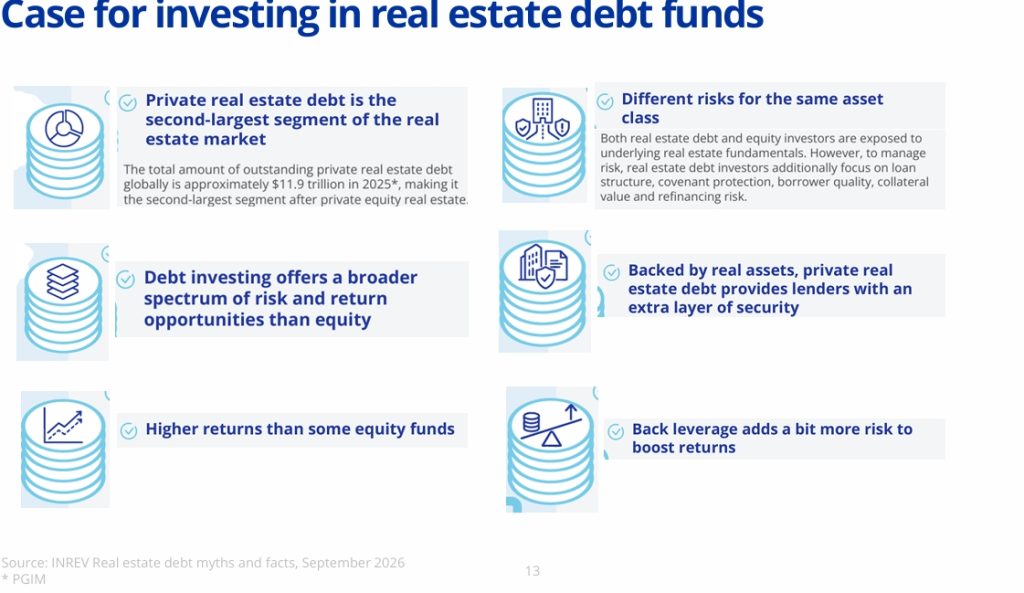
“Debt investing offers a broader spectrum of risk and reward opportunities than equity, and higher returns than some equity funds”, she said. “Private real estate debt provides lenders with an extra layer of security as it is backed by real assets, but back leverage adds a bit more risk to boost returns.”
Alternative lenders are gaining market exposure in Europe, the latest INREV Consensus Indicator Survey shows, and lending terms remain competitive, although the first signs of a slowdown are visible. “Last year in the UK for the first time ever alternative lenders were more active than traditional lenders”, Pylypchuk said. There is a lot of competition for product among alternative peers and often also against traditional lenders.
There are some glaring differences between the US market, where open-ended funds dominate, and the European market which is dominated by closed end vehicles. “It is easier to monitor the performance of open-ended funds and to understand their key metrics, but in Europe we have the opposite situation”, she said. “There is no standard or consensus on investment approach, good practice or a common terminology. We are witnessing a fast-paced evolution, but with limited data and a lack of transparency.”