Savills’ 2026 Logistics Real Estate Census points to strong take-up levels across Europe
Logistics occupiers are more optimistic about the outlook for the sector but energy and power availability are a serious challenge, delegates heard at the 2026 European Logistics Real Estate Census presentation, organised by Savills and Real Asset Media, which took place online on Friday.
“More occupiers see business conditions improving this year, and 92% of them expect to take the same or more space over the next three years”, said Kevin Mofid, Director, Head of EMEA Industrial & Logistics Research, Savills. “The Census points to a slower and more selective market, not a fundamentally weaker one.”
The 6th annual census, produced by Savills in partnership with the specialist real estate research firm Analytiqa, gathered the views of 628 participants, including occupiers, investors, developers and consultants across the EMEA region.

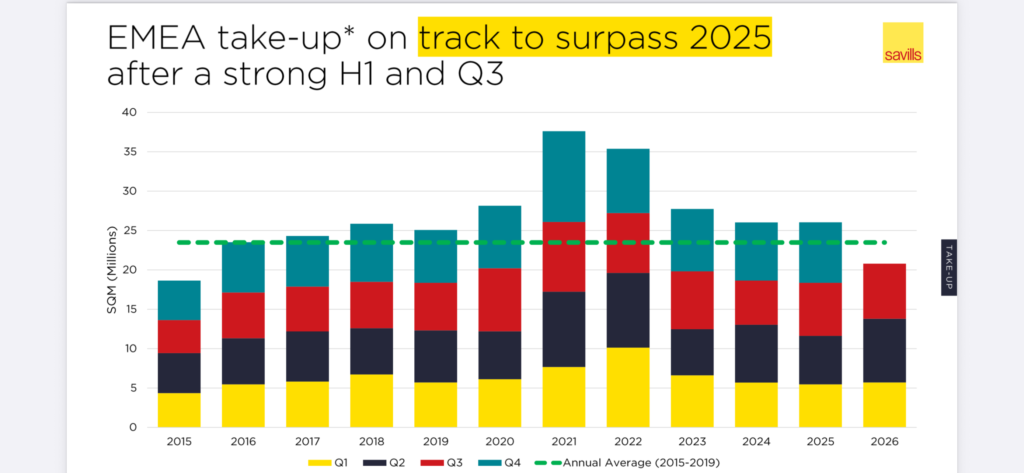
Despite the backdrop of geopolitical volatility, uncertainty over trade policy and a high cost of capital, which has lengthened decision-making cycles, the occupational market has remained remarkably resilient. Take-up volumes reached 14.01 million sq.m in H1 2026, up 21% year on year, and Q3 was strong as well.
“Take-up levels have been really strong and now in Q4 we are ahead of where we were last year”, said Mofid. “The market is performing really well across Europe and we expect the vacancy rate to drop in 2027.”
The vacancy rate is stable at 6.3%, but there are big variations between locations. Overall, though, as take-up increases there will be less vacancies because there is less speculative development happening. Looking ahead, this means a likely supply squeeze in the next few years, which will inevitably have an impact on rental growth.
The year-on-year improvement is positive and largely driven by businesses placing greater emphasis on supply-chain resilience, nearshoring, inventory security, and network efficiency. Since the start of the Iran conflict supply chain resilience has been a key theme shaping the market.
Resilient demand is being driven by occupiers redesigning supply chains for greater security, efficiency and long-term resilience. “The market has experienced multiple shocks since 2020, and occupiers are proactive rather than reactive, unlike during the pandemic”, said Mofid. “This helps explain why leasing activity can remain robust even amid weaker economic growth. Occupiers are not simply adding space. They are reconsidering where they hold inventory, how they configure distribution networks, and whether existing buildings can support more automated and power-intensive operations.”
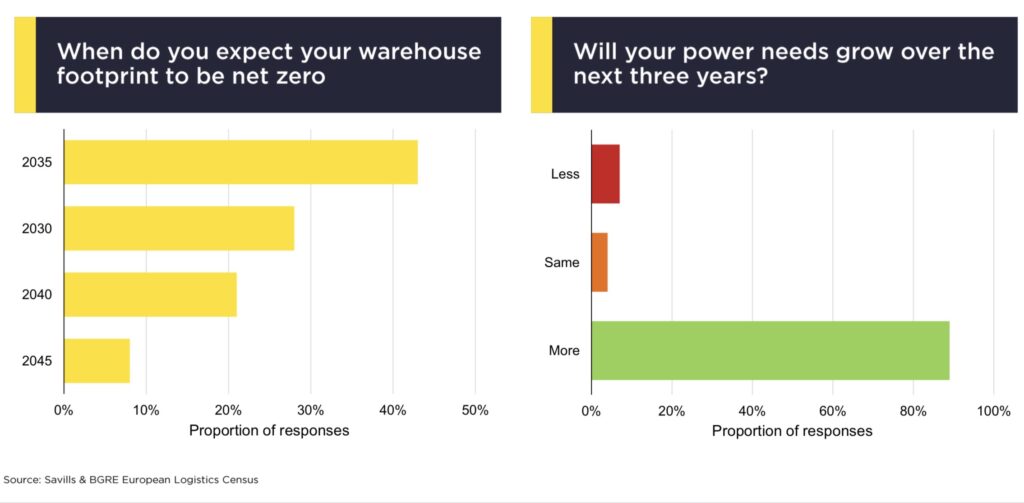
Energy and power are key factors moving forward: over 80% of survey respondents say they will need more power. “Power will be the defining factor of the next ten years”, said Mofid. “It will continue to drive occupier requirements.”
Renewable energy is seen as an immediate priority. ESG compliance remains a strong commitment, and the majority of companies plan to reach net zero by 2030 or 2035.
Despite strong leasing momentum, however, investment activity remains subdued. European industrial and logistics volumes reached €18.7 billion in H1 2026, 10% below the long-term average. Financing conditions and uncertainty continue to slow transactions, directing capital towards higher entry yields, secure income and assets underpinned by robust occupational demand – especially as operational suitability will be central to both liquidity and performance.