

CEE Summit: more diversified investor base in Poland now
Poland is seeing a more diverse mix of domestic and foreign investors, delegates heard at the ´Alternative Financing & Investment: Who Will Finance CEE Next, and How?´ panel, which took place in Warsaw at the recent CEE Summit, organised by Real Asset Media and The Poland Observer.
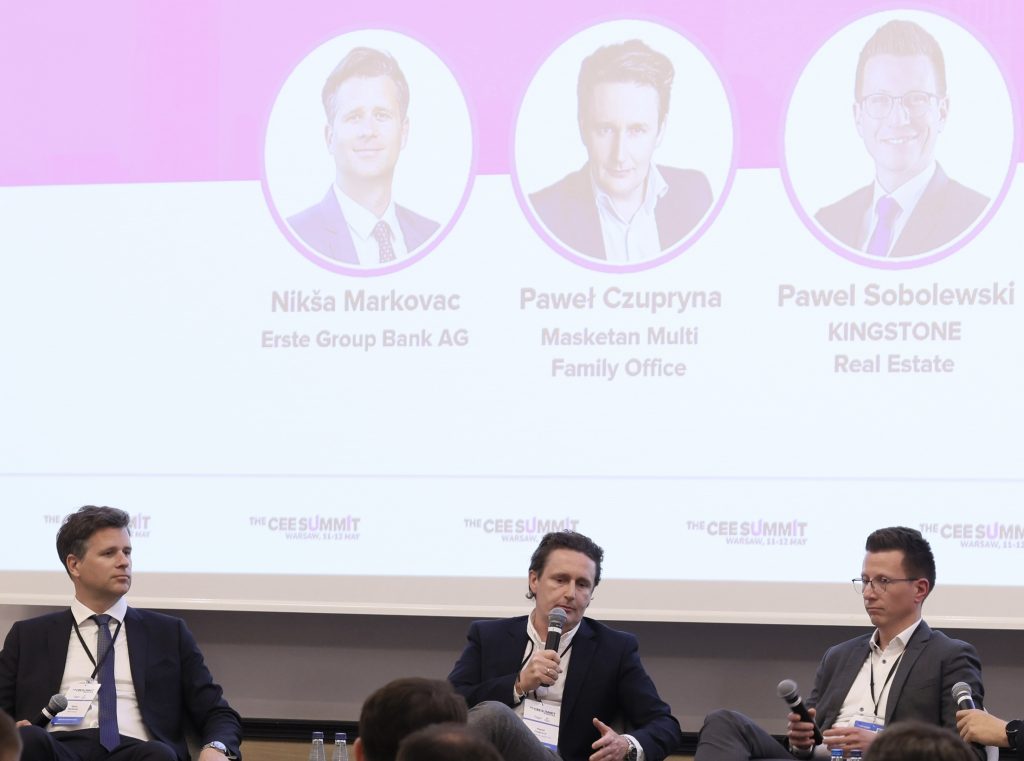
¨We see that there´s a portion of capital from abroad, especially from Western European countries that is shifting to Poland, because there was historically a huge allocation of capital, for example, to Germany,¨ said Pawel Sobolewski, Managing Director Poland | Head of Fund Management, Kingstone Real Estate. ¨There was a trend of Germany as a safe harbour, but now Germany has some difficulties, so in diversification terms it makes sense to enter other countries and regions. And obviously Poland, as it is in the middle of Europe and has good economic prospects, is a good destination. As an investment asset manager, we see more and more investors coming to Poland. We already closed some transactions and are working on some new ones, so we have a very positive perspective.¨
Real estate investments in Poland have traditionally been dominated by international capital, and foreign money continues to come in, but in a more recent development local investors have become more active in the market.
¨When the war started in Ukraine, many transactions that involved foreign investors were put on hold, and obviously this was a problem for the local investment community,¨ said Paweł Czupryna, Managing Partner, Masketan Multi Family Office. ¨And suddenly, we realised that if you want to do this, you have to do this with local money, meaning CEE capital, not just Polish. This was also a big wake up call for me that there actually was a lot of capital here. We are starting from a very low base, but this private capital is growing. These are business owners becoming investors, it is a new phenomenon, not like in Germany or other Western markets where there are family offices that have been active for generations. And sooner or later, they will create structured family offices or other sorts of vehicle. So this private capital is definitely growing in the region and in Poland.¨
This will be a vital source of capital. It will never replace, and it was never intended to replace, banks, but it will fill the gap between senior debt and equity and bring Poland in line with other attractive investment destinations.
There are many advantages to this, said Czupryna: ¨We should not forget that 50% of GDP in Poland is generated by SMEs, which need capital but maybe for strategic investors and for banks this smaller segment is a bit complicated and maybe too risky. The advantage you have is that the decision making is fast and flexible. Quite often, this is local money, which understands the local needs and problems. They know how it works. You can explain the structures and the complexity. Family offices have the local knowledge and understanding but they also have a longer investment horizon, they are not looking at fundraising in this cycle, deploying capital and then exiting. In the real estate sector foreign capital still plays the biggest role, but things are changing.¨
There are family offices from different countries investing in the region, said Sobolewski: ¨We see quite a lot of family offices from Western Europe. For example, we have Danish family money investing in Croatia. We have Swedish family money investing in Hungary. And Poland is moving in that segment the fastest, attracting family money from other countries. I guess Poland is seen as a safe harbour because of its size, because of the presence of large investors, because of how fast you can resell the property, which is not necessarily the case in some other markets.¨
The involvement of other forms of capital is a good thing for the country and the region, he said: ¨I regard it as a positive development. The more diversified the capital base in Poland the better. Also an interesting field for the future is structured finance, debt financing, mezzanine financing, which are still underestimated in Poland but will probably become more attractive in the future. We at Kingstone already have a debt fund in Germany, are investing in development in the German market and would like also to explore similar structures in Poland in the future.¨
One of Poland´s attractions for investors is that, like Germany, it has several important cities where it is possible to deploy money beyond the capital.
¨Poland for us, due to its size and to the presence of the international community is currently the most active and the most interesting¨, said Nikša Markovac, Head of Commercial Real Estate International, Erste Group Bank. ¨The difference if you compare it to other markets we represent like Hungary or Slovakia, Czech Republic, Croatia, Serbia and Romania, our other core markets, then the difference is that in Poland you don´t just have Warsaw but also Gdansk and Krakow and five other big cities. And in each of those markets, there are amazing opportunities in logistics and a lot of potential in the retail segment, although offices means mainly Warsaw or Krakow.¨
Poland can almost be regarded as a safe haven now, experts agreed.
¨We already have good fundamentals and the forecasts are positive¨, said Sobolewski. ¨We have a good economy, but still we have some constraints, which mostly relate to a lack of a track record and liquidity in the market. Once these components are present, Poland will be the safe harbour of Europe in the future.¨


