

CEE Summit: region’s outlook positive if it stays the course
The outlook for Central and Eastern European economies is positive, provided politics does not interfere, delegates heard at the CEE Summit, organised by Real Asset Media and The Poland Observer, which was held in Warsaw recently.
“If there is no political accident, much of East-Central Europe can continue to outperform”, said Holger Schmieding, Chief Economist, Berenberg, in his keynote presentation on “Coping with disruption – the economic outlook for Europe and the CEE region”.
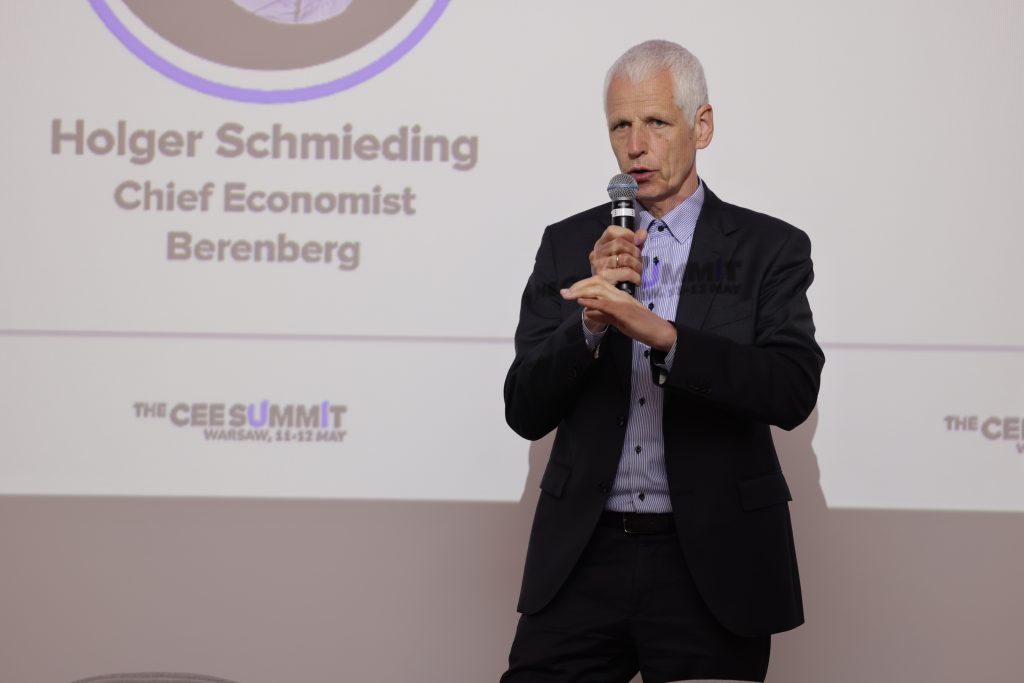
There are short-term problems, especially in countries like Slovakia that are exposed to the German car industry in crisis. “But beyond that, the outlook for the region remains fairly favourable, as long as one lesson is heeded”, he warned. “Don’t do Orbàn.”
Under the former prime minister of Hungary, who recently lost the elections after 16 years in power, the country has underperformed because of “too much crony capitalism and too much undermining of institutions, which is negative for investment”, he explained.
Most countries in the region have fared well in the last twenty years, and Poland is the key example of that. While investment in Poland is 18% higher than in 2019 and exports have increased by 30% since then, in Hungary they have both declined.
“Poland is one of the miracle economies of Europe, which since around 1992 has outperformed almost all its peers”, Schmieding said. “Warsaw already looked good ten years ago and it looks even better now. And the same holds for some of the other parts of Poland.”
One statistic illustrates the changes underway: Germany now exports significantly more to Poland than it does to China. Poland takes 6.5% of German exports, China only 5.6%. This shows that now there is “a clear tendency towards trading more with friends, investing more in friends and neighbours, rather than with the US and China”, he said.

This tendency is a positive for Europe. Until now it has just “bumbled along”, but at least it has not made big mistakes and things might be looking up. “The outlook for the European economies beyond the Iran war is a gradual return to normal growth, culminating in a mini boom, probably late 2027 or 2028”, Schmieding said.
A lot depends on Germany and how fast it proceeds with is fiscal stimulus. Spending on defence and infrastructure will over time give a significant lift to the German economy, which will also benefit from planned supply side pro-growth reforms, the speeding up of approval procedures, a cut in business taxes and a better migration policy, focussing more on migration into the labour market.
If all that goes according to plan, Germany will do better in a year or two and its performance will lift the whole of Europe. “Without Germany, the rest of the Eurozone had decent growth last year, its trend rate, which is roughly 1.2%, but it was Germany’s meagre 0.4% which pushed the overall Eurozone number down”, he said. “So if Germany does less badly, and we are in a situation where the Eurozone has normal growth, we can hope for a mini boom.”
The US and China, on the other hand, face serious challenges. “If it wasn’t for Trump I would be giving you a very upbeat speech about the global economic situation”, Schmieding said. “Before Trump started this war of choice against Iran the world economy was heading for a year of slightly better than normal growth. There were no huge problems in the advanced world which needed immediate fixing.”
Now some experts talk about the war being potentially the biggest shock to global energy markets in living memory and Europe is facing the risk of recession if the Strait of Hormuz is not opened again soon. However, the most likely scenario is some kind of deal with sanctions relief for Iran and some Iranian concessions on their nuclear and missile arsenal and ambitions.
“Markets’ reaction will be immediately positive, while economies will take a while to recover because there are logistic lock jams which will probably take three months to clear”, he said.
The outlook for the US economy is not positive, with the growth forecast downgraded from 2% to 1.5%, mainly because “the US is hurting itself quite significantly with its migration policies, plus the tariffs, which give an incentive to invest in the less productive sectors, plus all the confusion of Trump”, he said.
If the US is crying, China is not laughing. On the surface it looks extremely strong and its performance in terms of manufacturing and exports is stellar. But its domestic economy is not doing so well, because domestic consumption is very weak. “In terms of its global share of GDP, China is probably beyond its peak”, said Schmieding.


