

Logistics market robust, rental growth weak: Garbe Pyramid
It is a time of modest rental growth and stabilization for the logistics sector, delegates heard at the ‘Garbe Pyramid H1 2025: European Logistics Real Estate Markets between awakening and stagnation’ presentation, organised by Garbe and Real Asset Media, which took place online on Tuesday.

“We are expecting an average annual rental growth of 1.9% in 2025, compared to an annual average growth of 5.6% between 2020 and this year”, said Tobias Kassner, member of the Executive Board & Head of Research & ESG, Garbe. “The exceptional rent surge of recent years cannot be sustained indefinitely. However, our forecast reveals that prices continue to be stable, and high-end locations retain their growth upside.”
The latest Pyramid Map – now in its 10th edition – provides an update of prime rents and prime net initial yields for the 121 most important logistics real estate submarkets in 25 European countries. For the first time The Pyramid also contains additional forecasts for the 88 regions, compiled in collaboration with Oxford Economics.
In H1 rental growth has not only been more moderate than in recent years, but it has also lagged behind the inflation rate, projected at around 2%. Rents remained stable in 71 of 121 regions examined (59%) and only 5% of the regions reported falling rents – down from 8% as recently as year-end 2024, which suggest that the market is stabilizing.
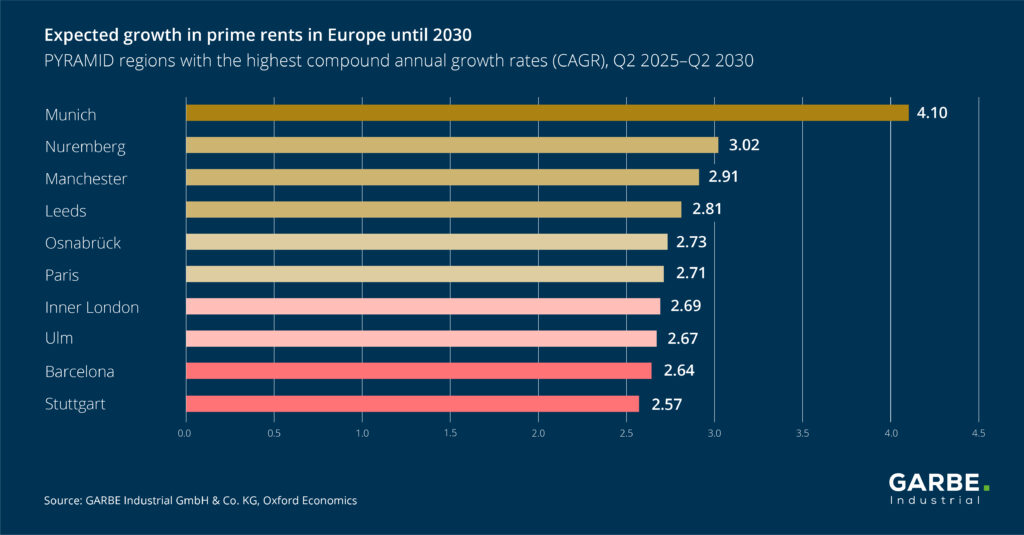
The top markets remain the market drivers. Places like Munich, Stuttgart, Inner London, Manchester, Paris, Barcelona and Warsaw will keep seeing above-average rent growth of more than 2% in the coming years, according to the forecast. Munich is well ahead of the pack with an expected rent growth of 4.1%.
In Germany, 11 regions showed a positive trend, including five of the seven largest logistics locations, but Leipzig and Magdeburg registered falling rents. “The German market is gradually coming back to life, while market action in Austria and the Czech Republic is rather subdued”, said Kassner.
Five of seven regions in Italy, three out of four markets in Spain and four out of ten regions in France recorded rent increases. Rental growth slowed in the United Kingdom and in the Netherlands.
Cross-European take-up followed the same long-term trend and generally matched, or fell slightly short of, recent levels, Garbe said. The average vacancy rate in Europe already exceeded 6.6% during the first quarter of 2025. While the United Kingdom, Italy and Slovakia recorded the fastest increases in vacancies, there are first signs of recovery in Germany, Spain and Poland.
“We expect many markets to see continued if more moderate rent growth, driven by structural trends, industry-specific demand and regional dynamics,” said Kassner. “The overall picture suggests that, despite slowing momentum, the market has remained robust.”


