

Mipim: European logistics market reaches bottom of cycle as demand returns
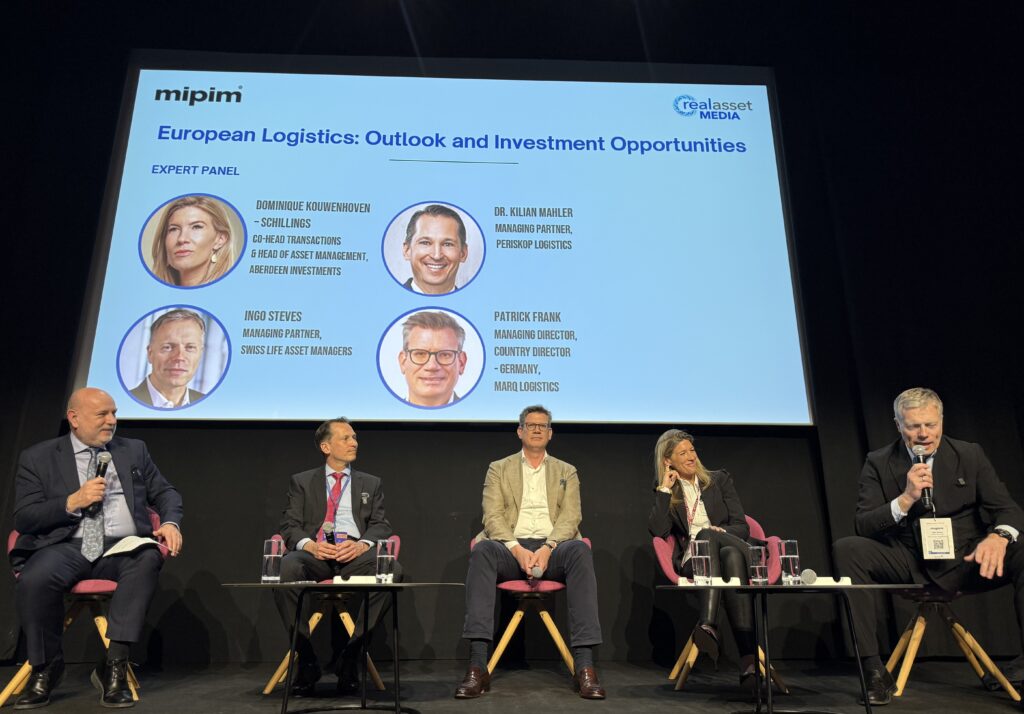
Europe’s logistics property market has reached the bottom of the current real estate cycle and is beginning to stabilise, industry leaders said during Real Asset Media’s session “European Logistics: Outlook and Investment Opportunities” at Mipim in Cannes on Wednesday.
Panellists said the sector is emerging from a period of pricing correction and rising vacancy, with occupier demand starting to strengthen again while development activity remains constrained across many European markets.
Dominique Kouwenhoven–Schillings, co-head transactions and head of asset management at Aberdeen Investments, said the sector has matured significantly over the past decade and is now entering a more stable phase.
“The same vibe I experienced at [EXPO Real 2025] is that there was certainly in the logistics sector — a maturity — and I think that’s what we see,” she said.
Dr. Kilian Mahler, managing partner at Periskop Logistics, said market pricing had corrected over the past year and the sector was now entering a new phase of the property cycle.
“Last year, we still saw corrections concerning pricing. Today, we see the start of a new cycle, so we have reached the bottom of the cycle and I think today we have a chance of also increasing price level,” he said.
Mahler added that occupier demand is beginning to recover after vacancy rose in 2024 and 2025.
“We had a very attractive rental market in 2022, 2023 then vacancy rates increased in 2024, 2025 and now we see some trends coming up like from the defence sector, e-grocery, pharma industry. Asian companies are also looking for space, so we see more potential or more demand for logistics space.”
Patrick Frank, managing director, country director — Germany at Marq Logistics, said investment pricing has stabilised following the repricing triggered by higher interest rates.
“Price correction has been completed. We now have a pretty good feel and a pretty firm grip on what is now prime and what is the pricing for prime,” he said.
Frank added that prime logistics yields in Germany now range “between maybe slightly below an initial of 5%”, highlighting the sector’s resilience compared with other asset classes.
“Price correction for office and other asset classes have been way more significant compared to logistics,” he said.
Panellists also highlighted how logistics networks are increasingly shaped by major transport corridors and inland distribution hubs. Frank said inland ports are becoming a critical part of European supply chains.
“This is exactly the backbone. For instance, along the Rhine river, one of the important commercially used rivers in Europe and we see a lot of inland ports locations,” he said.
He added that smaller distribution hubs are also emerging as cities look to balance logistics demand with planning constraints.
“The way we are currently experiencing, for instance, the exchange with municipalities in cities, this is exactly the topic around the small hub point,” Frank said.
Other panellists said strong structural drivers for logistics demand remain in place despite softer leasing conditions in the past year.
Ingo Steves, managing partner at Swiss Life Asset Managers, said demand remains supported by long-term supply chain trends.
“The structural drivers for demand for logistics [are] still very active. Demand is a little bit soft but [it is] getting better,” he said.
The panel also highlighted new occupier demand linked to defence and infrastructure investment across Europe, with Mahler noting that several governments are expanding military and logistics facilities to support long-term strategic programmes.
The session was moderated by Richard Betts, Real Asset Media’s group publisher.


