
Global FDI rebounds, but developing economies risk being left behind as investment becomes more selective

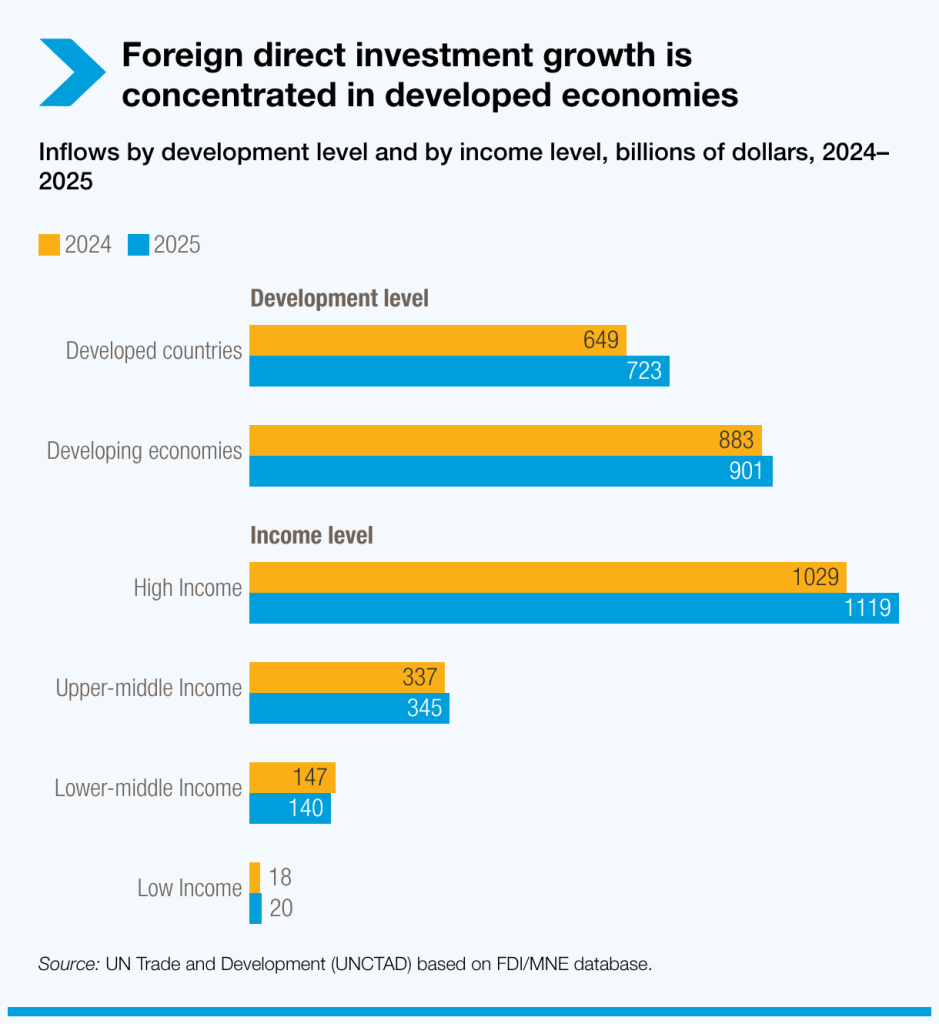
Global foreign direct investment (FDI) rebounded in 2025 after two consecutive years of decline, but the recovery masks growing disparities in where capital is flowing and raises fresh concerns that many developing economies are being left behind.
According to UN Trade and Development’s (UNCTAD) World Investment Report 2026: International Investment in a Turbulent Era, global FDI rose 6% to $1.6 trillion in 2025. However, the increase was concentrated in a relatively small number of countries and sectors, reflecting a profound shift in investor priorities amid geopolitical tensions, industrial policy competition and rapid technological change.
The report finds that while overall investment has recovered, international capital is becoming increasingly selective. Around 80% of global FDI is now concentrated in just 20 economies, with advanced economies capturing the bulk of new investment while many developing countries continue to struggle to attract productive capital.
Rather than being driven primarily by cost efficiency or market access, investment decisions are increasingly shaped by strategic considerations including national security, supply chain resilience and technological leadership.
AI drives investment surge
Artificial intelligence has emerged as one of the dominant drivers of international investment, with unprecedented capital flowing into AI-related infrastructure, including data centres, semiconductor manufacturing and digital infrastructure.
UNCTAD warns that while this surge is boosting global investment totals, the benefits are unevenly distributed. Most AI-related investment is flowing to advanced economies with established technology ecosystems, abundant energy supplies and governments able to deploy substantial industrial incentives. Developing economies have so far captured only a small share of this rapidly expanding investment market.
The shift reflects a broader transformation in global investment patterns.
Increasingly, governments are actively steering investment into strategic industries through subsidies, incentives and industrial policies designed to strengthen domestic competitiveness and reduce geopolitical vulnerabilities.
A more fragmented investment landscape
The report argues that international investment is entering a new era characterised by fragmentation rather than global integration.
While multinational enterprises continue to internationalise their operations, location decisions are increasingly influenced by geopolitical alignment, resilient supply chains and access to critical technologies alongside traditional commercial considerations.
For developing countries, this creates a more challenging competitive environment.
Those unable to match the incentives offered by larger economies risk being excluded from emerging investment opportunities, particularly in technology-intensive sectors.
At the same time, traditional investment drivers—including low-cost manufacturing—are becoming less dominant as automation, digitalisation and strategic autonomy reshape corporate location strategies.
Implications for investment promotion
For investment promotion agencies, the report underscores the need for increasingly targeted strategies.
Rather than competing solely on labour costs or tax incentives, successful investment destinations will need to demonstrate long-term policy stability, access to skilled talent, reliable infrastructure and integration into resilient regional value chains.
UNCTAD also emphasises that governments should continue pursuing policies that maximise the development impact of FDI, particularly through stronger linkages with domestic firms, technology transfer and sustainable industrial development.
Quality matters as much as quantity
Although the recovery in global FDI is welcome, the report suggests that headline figures alone no longer provide a complete picture of international investment.
The central challenge, UNCTAD argues, is no longer simply attracting more investment, but ensuring that investment contributes to broader economic transformation and sustainable development.
In an increasingly turbulent global environment, countries that can align investment promotion strategies with long-term industrial priorities, technological capabilities and investor confidence are likely to be best positioned to capture the next wave of international investment.