

Strategic realignment and selectivity will shape 2026
What trends, motives or drivers will shape the FDI landscape and investment flows in 2026?
In 2026, foreign direct investment will be shaped by a combination of strategic realignment and selectivity. Investors are no longer pursuing global expansion for its own sake: instead, they are prioritising resilience, market access, policy alignment and long-term stability.
This reflects a world where geopolitics, supply-chain security, technological sovereignty and sustainability considerations are increasingly intertwined with investment decisions.
For investment promotion agencies, this means that FDI is becoming more closely linked to national development strategies – particularly around industrial upgrading, digitalisation, energy transition and skills. Capital is still mobile, but it is more deliberate. Locations that can articulate a clear, credible investment narrative and demonstrate execution capacity will be best positioned to attract and retain investment.
What regions and sectors are you bullish about for 2026 and why?
Across WAIPA’s global membership, we see strong momentum in sectors that combine economic resilience with long-term transformation. Advanced manufacturing, digital services, clean technologies, life sciences and logistics continue to attract investor interest, particularly where they are supported by coherent policy frameworks and talent pipelines.
Geographically, regions that are successfully positioning themselves as reliable platforms within regional and global value chains, rather than competing solely on cost, will thrive. For IPAs, the opportunity lies less in chasing volume and more in attracting high-quality, sustainable investment aligned with national priorities.
What keeps you up at night or worries you about FDI in 2026?
One of the main concerns is the growing gap between investor expectations and on-the-ground delivery capacity. Many governments are ambitious in their investment strategies, but investors are increasingly sensitive to execution risks – whether related to regulation, infrastructure, skills or coordination across institutions.
There is also a risk of fragmentation in the global investment system. Diverging standards, protectionist tendencies and regulatory uncertainty can slow decision-making and discourage cross-border investment. For IPAs, navigating this complexity while remaining credible and investor-focused is an ongoing challenge.
Equally, what reasons do you find for optimism?
There are strong reasons for optimism. Governments around the world increasingly recognise the strategic importance of FDI, not just for capital inflows, but for technology transfer, productivity growth and job creation. This has elevated the role of IPAs from promotional bodies to strategic partners in economic development.
We also see growing professionalism and sophistication across the IPA community. Members of WAIPA are sharing best practices, embracing data and digital tools, and strengthening their investment facilitation capabilities. This collective progress is improving the overall effectiveness of the global investment ecosystem.
Any other thoughts you would like to share?
Looking ahead, the success of FDI in 2026 will depend on alignment — between policy and practice, ambition and capacity, and public objectives and private investment realities. IPAs sit at the centre of this alignment, acting as translators between governments and investors.
At WAIPA, our focus is on supporting members as they adapt to this evolving role: helping them move beyond promotion towards facilitation, aftercare and long-term value creation. In a more competitive and complex global environment, the locations that succeed will be those that combine openness to investment with clarity of purpose and the ability to deliver.
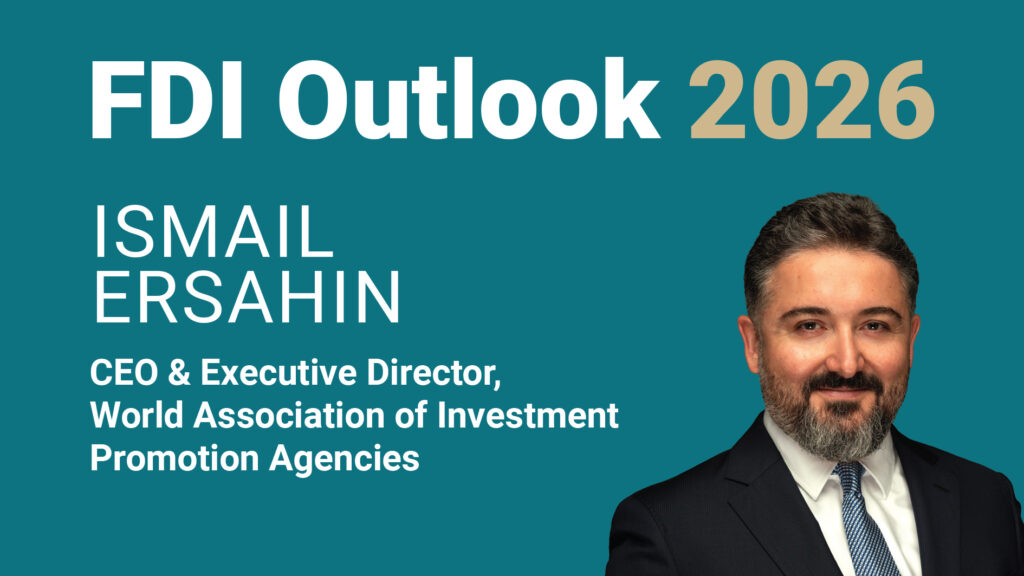
Ismail Ersahin, CEO & Executive Director, World Association of Investment Promotion Agencies
