
Europe regains momentum as strategic investment reshapes FDI landscape
Europe emerged as one of the biggest beneficiaries of the global recovery in foreign direct investment (FDI) in 2025, but the resurgence reflects a profound shift in the drivers of international investment rather than a return to pre-pandemic globalisation.
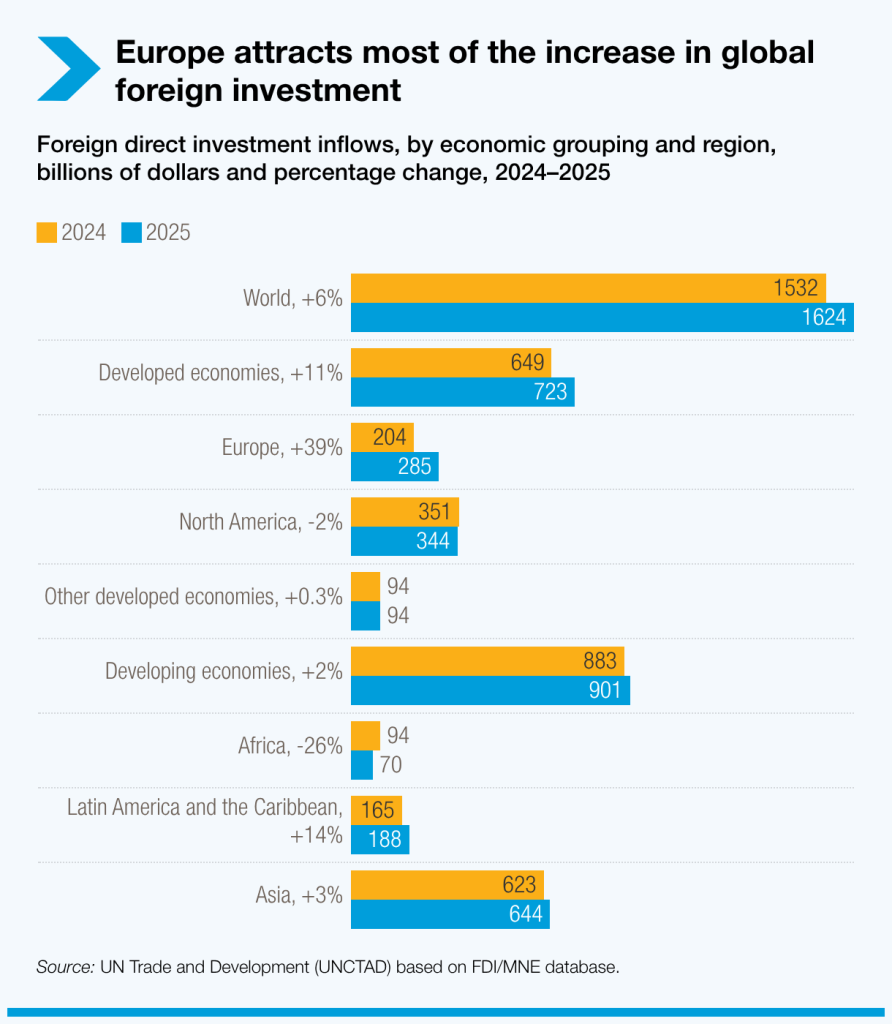
According to UN Trade and Development’s (UNCTAD) World Investment Report 2026, Europe accounted for much of the increase in global FDI during the year, with inflows rising to $285 billion, compared with $204 billion in 2024. More broadly, FDI into developed economies increased 43% to $728 billion, driven largely by Europe’s recovery and investment routed through major financial centres.
The rebound marks a sharp reversal after several difficult years, during which Europe experienced declining investment amid economic uncertainty, high energy prices and geopolitical tensions.
Yet UNCTAD cautions that the headline recovery masks a fundamental transformation in investment behaviour.
Strategic sectors take centre stage
Rather than being led by traditional manufacturing or market-seeking investment, Europe’s renewed appeal is increasingly linked to strategic industries prioritised by governments and multinational companies.
Artificial intelligence infrastructure, semiconductors, advanced technologies, energy transition projects and digital infrastructure have become the principal magnets for international capital.
Investment in these strategic sectors reached $576 billion globally in 2025, more than five times the level recorded in 2020. AI-related infrastructure alone accounted for around 60% of this investment, with Europe emerging as one of the principal destinations for overseas capital, particularly from US investors.
The findings suggest Europe is benefiting from a growing emphasis on technological capability, research ecosystems, regulatory certainty and access to highly skilled talent.
Industrial policy reshapes investment decisions
The report argues that international investment is increasingly being driven by industrial policy rather than traditional efficiency considerations.
Governments across Europe have expanded incentives aimed at attracting investment into strategically important sectors, while multinational companies are placing greater emphasis on supply chain resilience, economic security and access to innovation ecosystems.
This represents a significant departure from previous decades, when labour costs and manufacturing efficiency were often the dominant considerations in location decisions.
Today, companies are increasingly asking where they can secure reliable access to advanced technologies, skilled workers and supportive policy frameworks.
A more competitive environment
For European investment promotion agencies, the improved investment picture brings both opportunities and challenges.
Competition for internationally mobile investment is intensifying as governments around the world deploy increasingly generous incentive packages to attract projects in AI, semiconductors, clean technologies and advanced manufacturing.
UNCTAD recorded a record number of new government investment measures in 2025, highlighting the growing importance of industrial policy in shaping corporate investment decisions.
While Europe’s regulatory stability, sophisticated research base and large consumer market remain significant competitive advantages, investment promotion agencies will increasingly need to demonstrate how individual locations fit within evolving strategic value chains.
The outlook remains uncertain
Despite the recovery, UNCTAD stops short of declaring that Europe has entered a new investment boom.
The organisation warns that slower global economic growth, trade policy uncertainty and continuing geopolitical tensions could weigh on investor confidence during 2026, with companies delaying or cancelling projects as uncertainty persists.
Moreover, much of Europe’s improvement has been concentrated in relatively few sectors and countries, raising questions about the breadth and durability of the recovery.
For policymakers, the challenge will be translating renewed investor interest into broader industrial development, innovation and productivity gains.