

Gothenburg has to focus on what we control
What trends, motives or drivers will shape the FDI landscape and investment flows in 2026?
In 2026, companies will be more selective. With slower global growth, they’ll prioritise locations that feel stable and straightforward – an opening for Gothenburg.
As supply chains diversify, firms want an EU base that balances risk with access to skills, quality infrastructure and credible local partners. Rules around sensitive tech and data will keep tightening, so trust, compliance and transparency rise in value. We can turn that into a strength by showing how projects are handled responsibly here.
Investment will follow two big needs: more digital capacity (AI, data centres, chips) and more clean energy and electrification. These connect directly to our assets in mobility, batteries, energy systems, testbeds and university/industry collaboration.
The practical takeaway for Gothenburg is to focus on what we control: a clear value story, coordinated investor support, early access to the right partners, and reference projects that show speed, quality and outcomes. That combination helps investors move from interest to commitment, even in a cautious year.
What regions and sectors are you bullish about for 2026 and why?
I’m most positive about Asia, the US and parts of Europe. In Japan and Korea, batteries, advanced manufacturing and growing life-sciences links (medtech, precision health) match our research strengths and supplier base. In China, the battery value chain and smart manufacturing open scope for R&D and supplier partnerships.
The US remains a prime source for AI, data infrastructure, semiconductors and life-science platforms. These firms value talent, testbeds and a dependable EU entry point, where Gothenburg competes well.
In Europe, notably Germany, France and the UK, momentum in mobility, electrification and digitalisation aligns closely with our ecosystem across vehicles, batteries, charging and energy systems.
Construction is a specific priority for us here: Gothenburg is already delivering high-visibility, sustainable construction projects and intends to stay a leader. This is a practical place for international construction players to join, pilot and scale low-carbon materials, circular methods and smart building solutions with credible references.
These overlaps give us focused targets in batteries, mobility, digital tech, life sciences and sustainable construction, and a clear story for outreach in 2026.
What keeps you up at night or worries you about FDI in 2026?
Three risks stand out. First, hesitation: with mixed economic signals, some companies may delay otherwise solid projects, creating longer deal cycles and a slower pipeline. Second, bottlenecks: even when demand is strong, projects can stall on process complexity or scarce enabling capacity, particularly for energy and digital builds. That can shift decisions toward locations perceived as simpler or faster.
Related articles
- Swedish groups form $435m logistics JV
- Outlook 2026: investors drawn to senior living in the Nordics
Third, regulatory complexity: tighter screening regimes and evolving compliance expectations can add time and uncertainty to cross-border investments, especially in sensitive technologies. If these factors stack up, we risk momentum drifting to markets that offer quicker, clearer pathways from first meeting to first hire.
For Gothenburg, the response is to keep frictions low where we can, early coordination with partners, clear information, realistic timelines, and to help investors de-risk plans with pilots, staged commitments and strong local references that build confidence step-by-step.
Equally, what reasons do you find for optimism?
The long-term drivers are intact. Electrification, digitalisation and automation keep advancing regardless of short-term noise, and they continue to pull capital toward strong European bases. Gothenburg competes well on that front: we combine industrial depth with universities, testbeds and a collaborative culture that helps projects land and scale. Our track record in mobility, batteries and energy systems gives credibility with tech and infrastructure investors.
Life sciences add another pillar, linking research, medtech and data-driven health, while sustainable construction showcases real urban projects that international companies can join and learn from.
Global firms are still looking for dependable partners, qualified talent and places where innovation moves into operations. That’s our story. If we keep access simple, bring the right partners to the table early and show measurable outcomes, 2026 can be a year where Gothenburg converts cautious interest into committed, long-term investment.
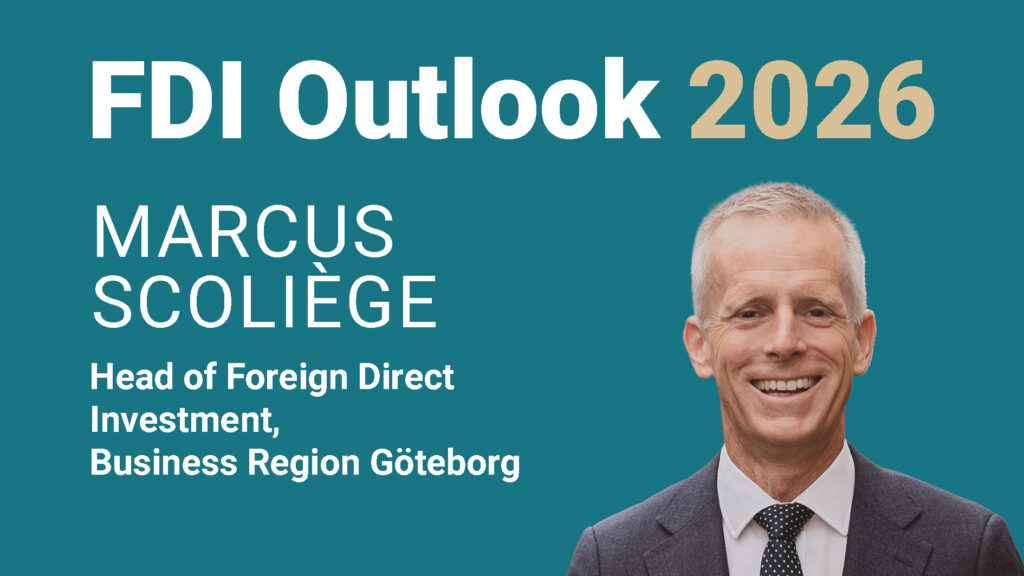
Marcus Scoliège, Head of Foreign Direct Investment, Business Region Göteborg
