

There is a global shift from volume to value
What trends, motives or drivers will shape the FDI landscape and investment flows in 2026?
AI diffusion, especially agentic AI, will accelerate cross‑border expansion and shape how firms assess locations. IP, compute availability, safety and AI governance now sit alongside talent and customers in decision frameworks. Governments are doubling down on tech sovereignty in semiconductors, quantum and data, rerouting supply chains via friendshoring.
Clean and digital transitions remain the central motives, with investors prioritising enabling assets, data centres and energy infrastructure.
Interest rate cuts are easing capital costs, bringing institutions back and shortening decision cycles. Place‑based innovation and anchor tenants will become more important to building long-term and durable ecosystems and spillovers. Our pivot to AI‑powered, precision FDI targeting deeptech and science‑led builders reflects the global shift from volume to value.
What regions and sectors are you bullish about for 2026 and why?
For regions, I would say the US, France, Germany, India and China, plus Canada, Japan, Israel, Singapore and South Korea, due to dense venture capital networks, frontier/deeptech clusters and strong outbound tech FDI. Watch market access and regulatory contours as part of the playbook.
Sectors would be deeptech (AI, agents and governance/TRiSM), quantum, semiconductors and life sciences (eg techbio, cell and gene therapies, diagnostics). Green innovation (smart mobility, smart buildings, green energy/finance); and hard tech and critical infrastructure (data centres, energy).
These match investor demand and London’s cluster strengths alongside fintech, creativetech and enterprise software, which remain important and more mature growth sectors. We have selective confidence in prime/green‑retrofit London offices, given their relative resilience
What keeps you up at night or worries you about FDI in 2026?
Rising protectionism, tariffs and data‑regulation divergence raise transaction costs and complexity. UK infrastructure frictions, for example power availability, planning timelines, build costs and policy uncertainty, extend time‑to‑land for high‑compute and R&D projects.
Frontier tech can underdeliver on short‑term given our job‑based GVA, risking misreads of performance without broader metrics. Global‑city competition for anchors is intensifying, while evolving AI rules add compliance complexity.
Execution risks include:
- Geopolitical fragmentation and tech sovereignty. Tighter export controls (eg, advanced chips), stricter FDI screening, and data‑localisation rules can delay approvals and reroute supply chains (friendshoring), elongating deal cycles and raising compliance costs.
- Power and grid constraints for high‑compute projects. Limited grid capacity, planning delays and power‑price volatility can stall data centres and advanced R&D facilities, an issue repeatedly flagged by investors assessing the UK/Europe.
- Regulatory divergence and incentive volatility. Rapidly evolving AI/data rules and shifting incentive regimes across markets increase legal uncertainty and can change project economics mid‑process, complicating board approvals and time‑to‑land.
Equally, what reasons do you find for optimism?
Macro tailwinds include rate cuts, returning institutional capital and strong appetite for data centres, logistics and energy infrastructure. London’s enduring advantages – for example, tech density, capital access and talent pipeline – are reinforced by the London Growth Plan, London Inclusive Talent Strategy and the national Industrial Strategy.
Our AI‑powered lead generation, VC‑signal integration and anchor‑tenant focus should lift conversion and cut time‑to‑land targeted precision over volume with clearer strategic long-term ecosystem impact.
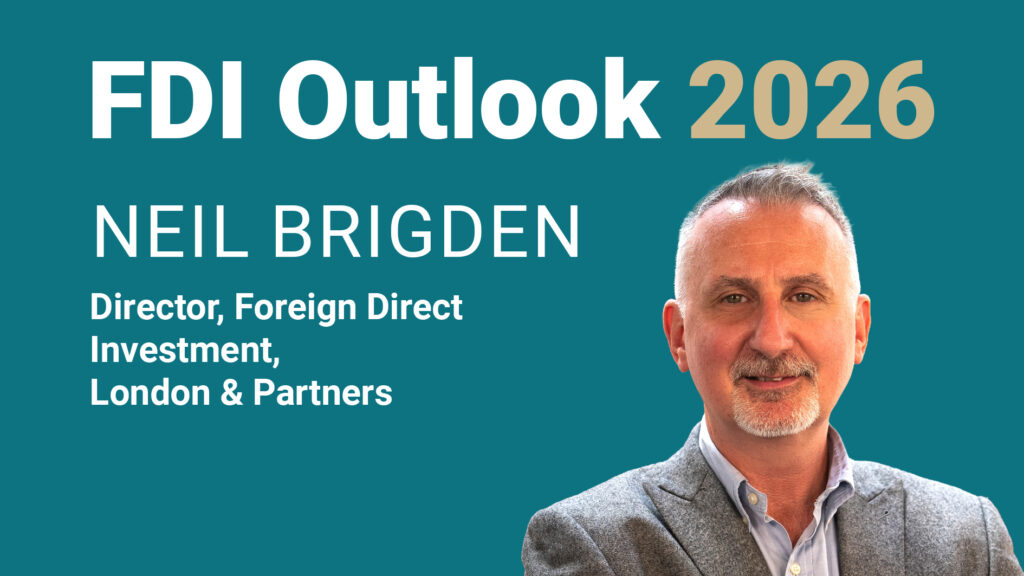
Neil Brigden, Director, Foreign Direct Investment, London & Partners
