

Briefing: AI is redefining Europe’s data centre investment case and risk calculations
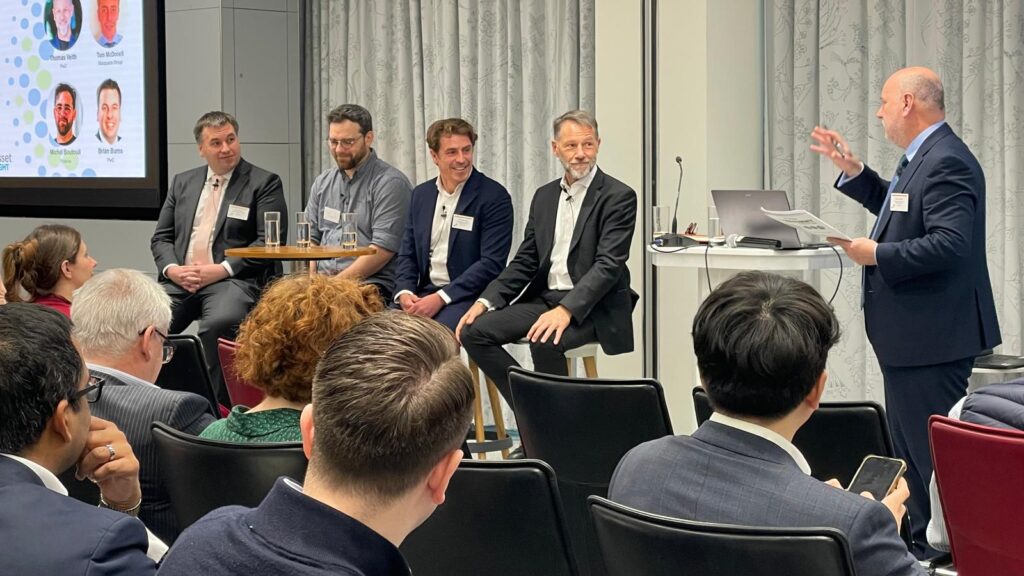
The rise of artificial intelligence is forcing investors to rethink what constitutes risk — and value — in Europe’s data centre market, with speakers at a recent Real Asset Media panel describing a sector undergoing structural change rather than cyclical growth.
The event was hosted by PwC in London on 20 January.
Brian Burns, PwC UK’s AI infrastructure leader, framed data centres as an execution-intensive asset class, warning that “raising the capital is only the first step — you then have to build them, and then run them.” He stressed that governance and operational maturity are becoming decisive differentiators as capital floods into the sector.
Michel Boutouil, CEO of data centre developer and operator Polarise, said AI has fundamentally changed how data centres must be designed and operated. “If you understand the IT, you know how to build a data centre to be future-proof for the next ten years,” he said, pointing to Polarize’s rapid six-month retrofit of a former banking data centre in Munich to support AI workloads. “Time to market is essential — if someone tells a customer it will take five years, we can compete by delivering in one or two.”
Boutouil recounted how Polarise took a former banking data centre that nobody wanted and rebuilt it from scratch in six months,” he said, underscoring how speed-to-market is becoming a competitive weapon in Europe, where greenfield development is often slowed by planning and grid constraints.
Tom McDonell, associate director at Macquarie Group,highlighted the changing investment calculus following early exuberance around AI infrastructure. “A year ago, everyone was throwing money at GPUs (graphics processing units); but the reality is that GPU financing is far more complex than many assume. Investors are now realising that not all compute is created equal, and that deep technical expertise is required to properly underwrite GPU transactions — especially in the neocloud segment,” he said. This dynamic is increasing concentration risk while opening opportunities for independent European platforms.
The discussion also underscored Europe’s distinct demand profile. While the US leads in AI model training, Thomas Veith, global real estate leader at PwC noted that Europe’s opportunity lies elsewhere: “Only around 10% of SMEs are using AI today; 90% will follow. That’s where the real growth is.”
As data centres become critical national infrastructure, sovereignty and resilience are rising on the investor agenda. Burns observed that enterprises are becoming “far more sophisticated about what data certainty actually means,” even if decisive shifts in behaviour are still emerging.
Burns highlighted the sheer scale of the investment challenge ahead, noting that “$1–$5 trillion of capex is expected in the data centre space over the next five years,” while cautioning that “building and running these assets is far more complex than the spreadsheet suggests.”
McDonell added that early 2025 marked a period in which the major hyperscalers deliberately paused new builds to firm up next‑generation designs and ensure their data‑centre and compute strategies were fully future‑proofed. “What looked like a slowdown was really a strategic recalibration,” he said. “By the second half of 2025, activity accelerated sharply as hyperscalers finalised their architectures and moved back into deployment at speed.”
He noted that this renewed acceleration was underpinned by a dramatic expansion of outsourced compute, including Microsoft’s $60bn neocloud agreements securing access to hundreds of thousand Nvidia GPUs.
Speakers agreed that future-proofing now requires deep technical understanding. As Veith put it, “Today, you need to understand every aspect of IT, energy and cooling—otherwise you carry the risk directly.”
